Announcement

This site will be migrating to a new address.
Please visit me at @Køkken and change your subscription to this blog to my RSS Feed

You Will Be Redirected!

Please do not leave any more messages on this blog. I will not be publishing or responding to any more comments left here. You will be automatically redirected to http://www.atkokken.com All posts have been migrated. You will be able to locate any posts by performing a quick search at my new site. Thank you.

Thursday, July 8, 2010

Black Glutinous Rice With Durian


Pulut 1

Pulot 6

Among the rice eating community here in Asia, the Japanese are possibly the ones who pays the most attention and dedication to the types and quality of rice they consume. The myriad of Japanese rice varieties available at the Japanese supermarkets fascinates me. A couple of months ago, I bought 3kg of Japanese short grain brown rice at the Japanese supermarket just so that I could use the rice polishing machine there. By turning the knob on the machine, I was able to select the different degree to which I would like my rice to be polished. Last month, during the Chinese dumpling Festival, someone was raving to me how the Japanese short grain glutinous rice makes really tasty sweet dumpling. During my last trip to Japan in April, my Taiwanese colleague had the gall to ask me to help him lug back the latest electric rice cooker that cost US$400! The latest model by Zojiroshi (the elephant brand) , it came with vaccumm and high pressure features that cook each rice grain to the core (including the harder brown rice) in a shorter time to yield a more fluffy and bouncy texture. I was intrigued, ...I was...but alas the voltage setting does not work in Singapore. Sigh, yes, almost all things made in Japan are good, (I hear protests over the recent Toyota debacle). Their dedication to and appreciation for quality and perfection are almost always reflected in the things produced in Japan.

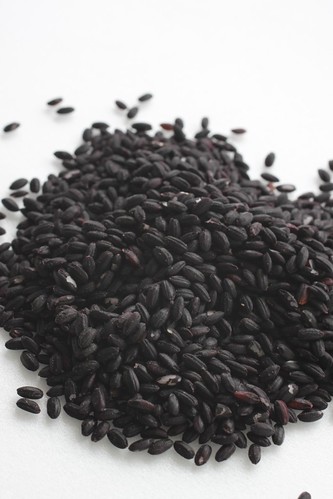
2 weeks ago when I was on my business trip in China, I had the opportunity to spend 2 days in Hong Kong while I was running between southern China and Shanghai. One of my favourite haunts in Hong Kong is the City Super Fine Food super market. This time, I must have spent close to 45mins, lingering over the Rice and Grain Section, peering at the different types of Jasmine rice, Arboria rice, Taiwanese short grain rice (these are also becoming really good) and the huge selection of Japanese rice stored specially like good wine in a dedicated refrigerator. I was particularly drawn to the short grain white glutinous rice and black glutinous rice. The Japanese short grain glutinous rice grains were snow white with a lovely luminescence while the black glutinous rice were jet black, plump and looked more like black sesame than rice. I had really wanted to get both but that would add weight to my luggage and I still have more than a week's travel to manage. In the end I chose to only get the black glutinous rice and for the rest of trip, I was contemplating about what to do with them when I get home.
Pulot 5

Pulot 4
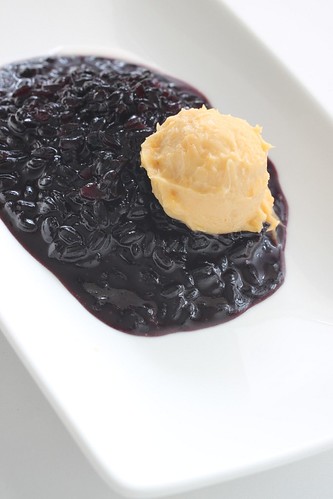
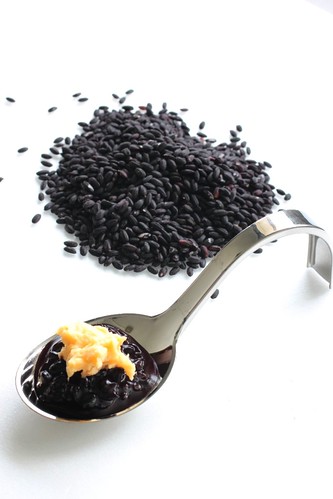
I am not very familiar with black glutinous rice recipes. The last black glutinous rice dish I had was 2 months ago in Taiwan when they served a black glutinous rice meat dumpling (紫米粽). It was really delicious (I think I still have 2 dumplings in my freezer!) and it did not make me feel bloated as normal glutinous rice would. Then there is the popular SE Asian dessert Pulut Hitam - which is Black Glutinous Porridge with Coconut Milk. It is a relatively simple dessert to prepare but is also rather uninteresting. It was only after poring over Forest Leong's Thai dessert, Mango sticky rice that I had my inspiration. Instead of water, I chose to cook the black glutinous rice in clear coconut juice. This imparts a refreshing, natural fragrant sweetness to the the porridge. When the rice was cooked, I stirred in minimal qty of coconut cream and served it with a dollop of seasonal durian pulp. As the durian season is at its peak, the fruit is very sweet and complimented the black glutinous rice rather well.

So, if you know of other black glutinous rice recipes, please do enlighten -I am looking forward to experiment with the rest of my short grain black glutinous rice.
Pulot 100

Recipe :

100g  Black Glutinous Rice, washed

3 Cups Coconut Juice
Sugar  To taste.
Salt     Pinch
2 Pandanus Leaves, knotted

20ml Coconut cream

Method :

1. Soak black glutinous rice over night and wash until water is clear. (water will purple in colour but should be clear)
2. In a pot place drained black glutinous rice, coconut juice, pinch of salt and sugar (I did not add sugar as I was happy with the natural sweetness of coconut juice) and pandan leaves. Bring to boil, lower heat to medium and continue simmer for 45 mins. I did this without covering the pot. If the water dries up, add more coconut juice or water.
3. When rice is cooked, (I cooked to soften with an al dante bite - some may prefer this to be more 'mushy') stir in coconut cream at low heat. Bring to low simmer for 2 mins. Remove from heat and cool down a little if preferred and serve with a dollop of durian pulp.

Monday, July 5, 2010

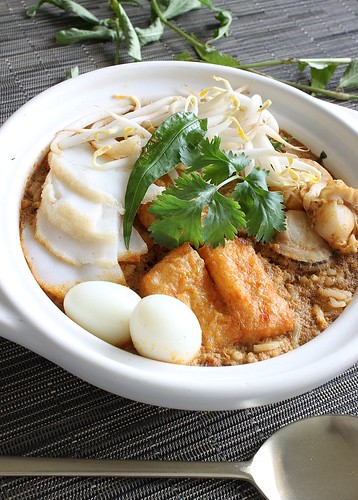
Laksa Curry Rice (叻沙加哩泡饭) - The Shanghainese Experience


Laksa Rice 2

Laksa Curry Rice 5

There are a couple of regrets about this Shanghai Business Trip -all related to food. We were grounded in a remote albeit beautiful hotel situated 1 hour away from downtown Shanghai. Meetings generally started at 8:45am in the morning and ran until 5:30- 6pm. The hotel's F&B capability was utterly disappointing. Buffet lunch spread was exactly the same everyday and the food did not taste good. The only Chinese restaurant in the vicinity served a mix of Spicy Sichuan food and Shanghainese cuisine but again it was just sub-standard stuff. I could tell that we were in for a disappointment when the Xiaolongbao (shanghainese dumplings) had a pastry skin that was thick and tough and that the Crab Roe Tofu (蟹粉豆腐) had a fishy stench.
On the one rare evening when I took my customer out to town for dinner, I had looked forward to revisit Justin Quek's creative French restaurant at Xintiandi. Justin Quek, for those who are not familiar is a Singaporean chef who struck out on his own after working at Les Amis. He opened his very first French restuarant in Taipei and was amazingly successful. He then went on to open some 3-4 restaurants at Shanghai's XinTianDi , a cluster of old Shanghainese style residencial buildings,石库门 (like the brownstones in New York) which has been preserved and converted to restaurants and bars. This is where foreigners come to find a slice of old Shanghai and Shanghainese go to connect with the Western world. I still remember my first visit to Quek's highly recommended La Platane restuarant, 梧桐 at Xintiandi. I had the Xiaolongbao with Foie Gras which was just amazing. This time,as I led my customer through  Xintiandi, I noticed something was wrong.Quek's bistro at the main restaurant aisle was missing and when I finally got to the site where La Platane used to sit,we saw that it had been replaced by a Spanish Restaurant. Needless to say, I was extremely disappointed. I was really suprised because I had thought it was a really successful and popular restaurant. Then, something spooky happened the next morning, my customer showed me a news article on his Iphone - Justin Quek apparently just got sentenced to jail and fined in Singapore for drunk driving.

So by the end of the 'food deprived' week, I became too weary to do anymore food hunting. After my last appointment in Nanjing, I checked into a hotel that was closer to the shanghai airport and it was when I was strolling in the food court next door that a stall selling Laksa Curry caught my eye. Calling themselves LaksaCurry, they were selling various dishes served with the Laksa gravy. Laksa apparently, has really become well received in Shanghai - the eatery stall at the Singapore World Expo Pavillion was selling among other things, Laksa, Kueh Pai Ti and Satay.

Business was brisk at LaksaCurry but one look at the gravy, I knew it would not be spectacular. Still, it was an irrestible option for me at that point. Their best selling item was apparently the Laksa Curry Rice served with Fish Cake (叻沙加哩鱼饼泡饭). We normally take Laksa with vermecilli noodles and I have also eaten laksa served with Rice Drops (Mi Tai Mak/ Louxu Fan老鼠粉). It has never occurred to me to eat Laksa gravy with rice... and I was fairly intrigued. As I tucked into the bowl of Laksa rice, I was strangely satisfied. The gravy, as I had suspected was not spectacular, it was watered down and not as fragrant as what we would have in Singapore. However, the familiar and comforting spiciness was exactly what I needed after a week of sub-par Xiaolong Bao, Giant Meat Ball (狮子头) and Crab Roe Tofu.

IMG_2461
Intent on recreating this with a more authentic Laksa Curry gravy, I decided that this would be the first thing to cook when I get back. For those who are too lazy to prepare the Laksa paste from scratch, there are many ready made paste in the supermarket but I have always been partial to Prima Taste's products. They are my crave saviour when I was stationed in China a few years ago.

Laksa Curry Rice 100
Recipe :
Laksa Paste
Lemon Grass        2 stalks
Blue ginger           40 slices
Candlenut            12
Dried Chilli          15 pieces
Shallots               25 pieces
Belachan             2 thumb sized knobs
Coriander powder 2 tbsp

Others
Dried Shrimps                 30g (soaked to soften and pound to coarse paste)
Chilli oil                           80g
Thick coconut milk          125ml
Water                             400ml
Bean sprouts                   As you like. Blanched in boiling water.
Cooked Rice                  1 bowl
Fried Fish Cake              Sliced and you can put as much as you like
Tofu Puff                         5-6 pieces
Laksa leaf                       2-3 leaves (cut into fine shreds)
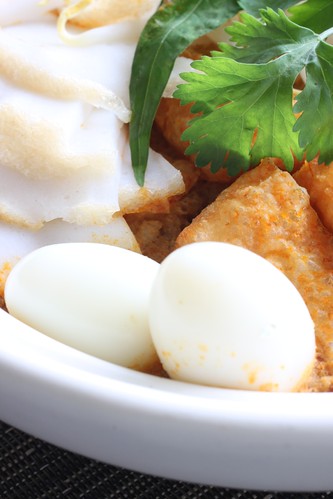
Quails Eggs                     Hard boiled. Peeled.
Salt                                 To season
Coriander leaf                 To garnish
Cooked Scallops             As you like. (alternatively, you can replace with shredded chicken)

Method :
Laksa Paste
1. Soak dried chillie in warm water until softened. Blend all ingredients in Laksa Paste except coriander powder in a blender. Add coriander powder last.
2. In a heated wok, add chillie oil and fry (1) until fragrant. Add pounded dried shrimps and continue to fry for 2 mins.
3. Increase heat and add coconut milk and water. Continue to stir. Add Tofu Puff and cooked scallops.
4. In another wok heat a little oil and add 2 cloves of garlic. Fry cooked rice until fragrant.
5. Dish fried rice into a bowl. Add Laksa gravy (3) over the rice.
6. Garnish with Laksa leaves, fish cake, quail's egg, bean sprouts and coriander leaf. Serve hot.

Sunday, July 4, 2010

World Expo In Shanghai

Pearl Tower


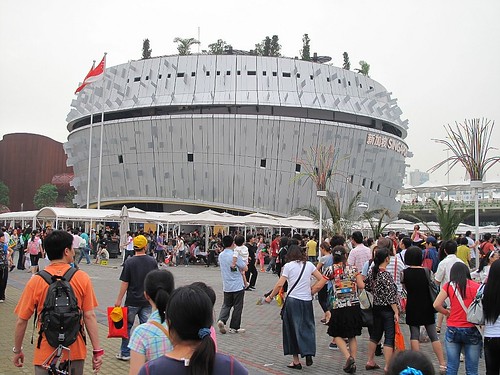
Singapore Pavillion
Singapore Pavillion
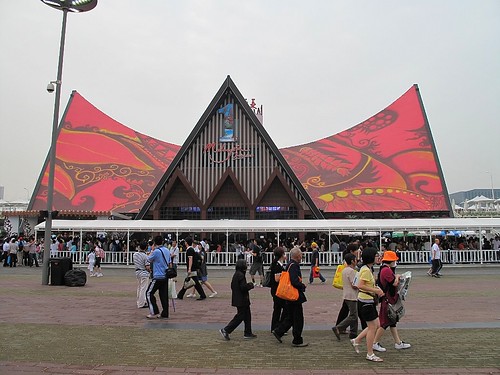
Malaysia Pavillion
Malaysia Pavillion
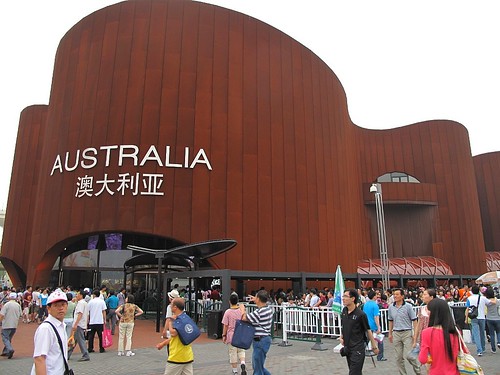
Australia Pavillion
Australia Pavillion
I don't think I have ever stayed so long in Shanghai - over a week. Shanghai is decidedly my favourite city in China. I like it because it is more cosmopolitan and it showcases the rich and colourful chinese culture in a manner that I can relate to - where I can pick out the charms and richness of chinese elements and still make them relevant to my lifestyle. Unlike the polluted industrial zone in Guangdong where factories seem to run 24 hours a day, Shanghai, though, also polluted, exudes a unique refined grace. Despite its modern skyscrapers, Shanghai is the Chinese city where I feel a well coiffed, cheongsam clad chinese lady would belong. She would look grossly out of place e.g. in Shenzhen or Guangzhou.

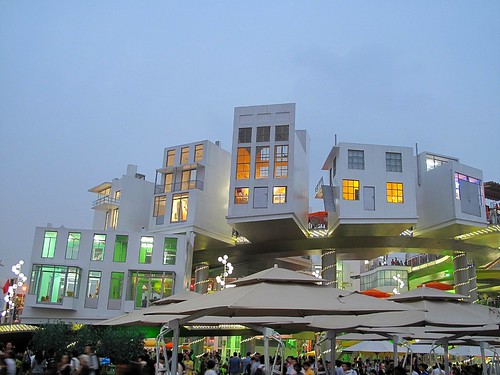
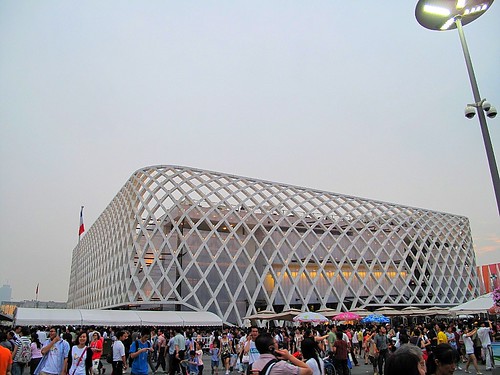
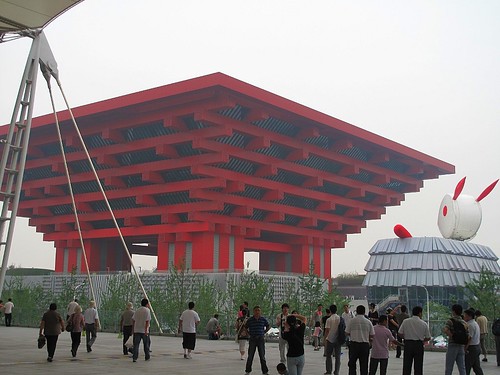
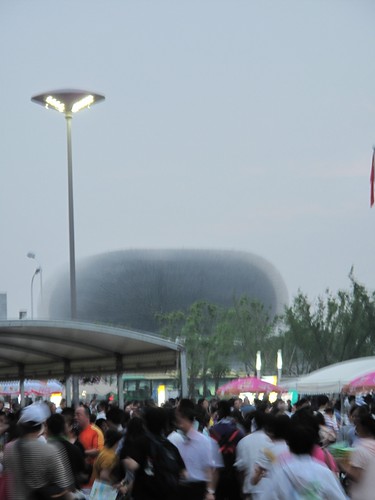
Grounded in Shanghai for meetings, it was only inevitable that I joined my other colleagues for an excursion to the Shanghai World Expo. I really didn't want to go, expecially during a weekend, because I know it would be sardine packed with people but my colleagues, including my boss from the US were all determined to check it out. We chose to go to the Expo on a Saturday evening at 5pm to avoid the crowd. By 4pm, the news on TV reported that they had clocked in 520,000 visitors for the day. The area was massive and the crowd was even more massive. The first cluster we hit was the SE Asian Pavillions - yes, I admit I had steered the group towards that general direction because I had wanted to see the Singapore Pavillion which had received alot of flak from fellow Singaporeans, ourselves. I didn't stand a chance to get into the Singapore Pavillion or for that matter, any pavillions. The queues were still windingly long and I estimated that if I had queued for the Singapore Pavillion, I would have to stay in line for at least 2 hours. I had heard that for the popular pavillions like Saudi Arabia, Japanese and Chinese Pavillions, visitors have to queue for 4-5 hours to get in. It sounds so silly to be wasting time in the lines but there were hundreds of thousands of visitors doing just that - they came prepared with food, drinks, umbrellas, fans and little stools to wait in line. I, on the other hand, just walked around, half-heartedly snapping photos of pavillions nestled in a sea of dark haired crowd.

Holland Pavillion
Netherland Pavillion
Germany Pavillion
Germany Pavillion
French Paviliion
French Pavillion
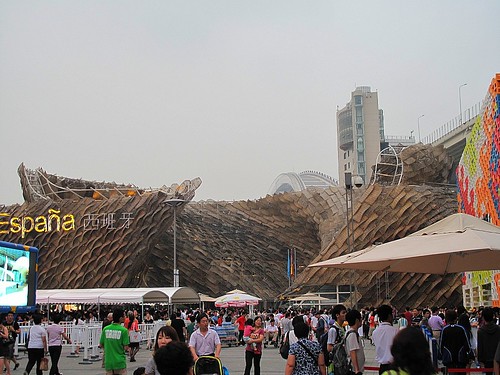
Spain Pavillion
Spain Pavillion
China Pavillion
China Pavillion with the Bunny Macau Pavillion next to it.
IMG_0910
English Pavillion

Among the Pavillions I had seen, I was most impressed by the Spanish and the English Pavillion. I was a little awe struck when the Spanish Pavillion came into my view. The facade was  built with wavy sheets of wicker structure. I thought I could vaguely make out the shape of a bull's horn from the construction. The English Pavillion caught my eye from afar. From a distance, it looked like a fuzzy oval shaped dome, appearing somewhat surreal and out of focus. The intriguing structure is made of steel rods poking out of the the dome, the different distribution density of the rods, created a halo like effect around it. Utterly cool and very very fashionable.
It was a shame that I had not been able to get into any of the Pavillions - I only wish that the Chinese government would limit the number of visitors per day. They are now targeting at around half a million visitors per day. For those of you who intend to visit the Expo during the month of July and August, good luck to you for school holidays have started in China and apparently many schools have made it compulsory for students to submit an essay on their visit to the World Expo.....Perhaps I will try to revisit the expo in September...fingers crossed.

Sunday, June 20, 2010

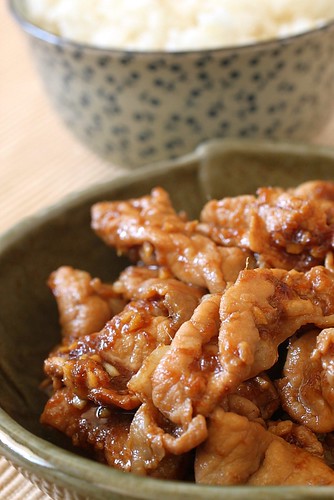
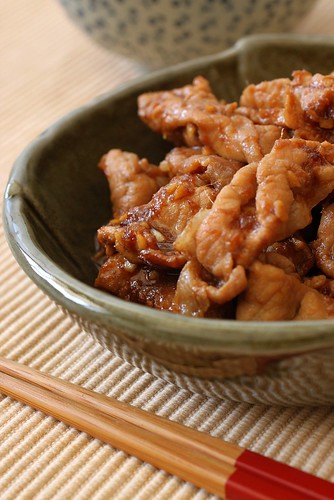
Pan Fried Ginger Pork - 豚のしょが焼き


Ginger Pork2


There was an article in the papers last week reporting that stocks of Japanese Kurobuta (black hog) and Japanese Wagyu Beef in Singapore are running low.  Following the break out of foot and mouth disease in Japan in April, the Agri-Food and Veterinary Authority of Singapore has put a ban on the import of these premium meat.

I am a big fan of Kurobuta which refers to the rare Berkshire Black Hog bred in Japan. It is the Wagyu equivalent for Pork. I still remember when I saw it many years back at the local Japanese supermarket, I was fascinated by the even marbling of the pork and subsequently, when I had the chance to taste it, I was quite impressed by how tender and flavourful it was. The best way to enjoy a prized meat as such would be to season it simply with salt and pepper and grill it. However, due to its rather expensive price tag, (S$4-S$5/100g) these are normally sold at the local supermarkets here minced or sliced thinnly in Sukiyaki or Shabu shabu cuts - not exactly the best cuts for grilling.
Ginger Pork 3
I was lucky to chance upon some US Kurobuta on sale last week. Choosing the Sukiyaki cut for more bite, I couldn't wait to cook this.
One of my favourite Japanese Pork recipe is the very accessible Pan Fried Ginger Pork.  Extremely simple and quick to make, this dish goes beautifully with steaming hot white rice. It is so flavourful that one runs the risk of having too much white rice with it. In addition, the grated ginger really lends a warm and comforting feel to the dish.

Of course, one does not need to use Kurobuta Pork for this but I do like my pork to be sliced very thinnly for this dish and the Sukiyaki cut would be my choice. So here's for all who needs to cook a quick,easy and tasty meal.

Ginger Pork (100)
Recipe :

Pork (Sukiyaki Cut)                 250g
Sake                                        1tbsp

Grated Ginger                          1tbsp
Grated Garlic                           1tsp
Mirin                                        1tbsp
Japanese dark Soya Sauce       1tbsp
Sesame Oil                               1tsp
Sake                                        1tbsp
Sugar                                        1/2 tsp

Method :

1. Marinate pork with 1tbsp of Sake and leave for 10 mins.
2. Mix all the other ingredients together and mix well with a fork.
3. Heat a frying pan and add 1/2 tbsp of oil. Fry marinated pork until pork changes colour.
4. Add the sauce mixture and let simmer for about 5 mins.

Friday, June 18, 2010

Bubble Tea - 珍珠百香果绿茶


Bubble Tea 2

Bubbles 8

Starch Ball Collage

Bubble Tea Collage 2

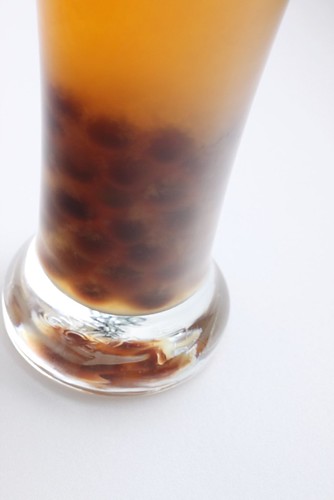
Bubble Tea - that one time ubiquitous beverage from Taiwan that got the whole Asian market smitten over its bouncy starch balls. For the lack of a better vocabulary to describe the texture of the bubbles, the Taiwanese have even coined a term of their own, describing the slightly chewy and bouncy bite as 'QQ'. I remember when this became popular about 10 years ago, franchise stalls of Bubble Milk Tea (珍珠奶茶) spawned like shoots after a rainy season. When everyone wanted a piece of the action, fierce competition set in, resulting in price erosion, unsustainable profits and eventually businesses folded like a pack of cards.

I suppose it was a relatively easy drink to make - it doesn't take much to figure out the recipe - Tea, Flavoured Syrup, Milk and of course the Starch balls. The ones that still remain in Taizhong, where this originated from invariably gain their popularity for their milky tea variety. I've heard how people had commented that they prefer the beverage from a particular shop because the milk tea is more fragrant.... well, this doesn't really appeal to me because I am not a milk tea person. I always take my tea and coffee black. Hence when I order a Bubble Tea, it is always a flavoured clear tea - for me, the pleasure in taking this beverage is chewing on the QQ tapioca starch balls (粉圆).

Recently I noticed a little revival of the Bubble Tea in my neighbourhood when a Taiwanese Bubble Tea chain store, KOI Cafe,(check out LadyIronChef's review)  opened its outlet here. I didn't try to go near the shop for a few months because everytime when I passed it, there was a long queue and there were people sitting on benches waiting for their order.... Finally one morning last week, on my way to the National Library, I took advantage of the thin crowd at the early opening hours of the store and ordered my first KOI Bubble Tea. I ordered a Passion Fruit Green Tea Bubble Tea with sugar content reduced by 50%. (Yes, you are allowed to select if you want the sugar to be reduced by 50%, 25% or no sugar addition) As I waited in anticipation with my queue number, I watched  the very young crew work behind the counter. Almost immediately, I began to wonder if this shop is all about gimmicks. I began to suspect that the long queues that I had seen before may not be due to the outstanding drink recipe - but rather the result of a deliberate attempt by the crew to stall time as they move about listlessly, chatting, poking fun at each other, without giving a care about the 10+ odd customers standing around like puppies, holding on to their queue tickets... waiting.  I got really impatient, my brows furrowed, my lips pursed into a tight unfriendly line. When I finally got my order, it didn't blow my mind away, in fact it tasted syrupy and coyingly sweet. If not for the starch balls, I would have thrown the drink away. Well, maybe my judgement wasn't fair - perhaps they are better at the milk tea formulations. If anyone has tried their milk tea, please do share your views.

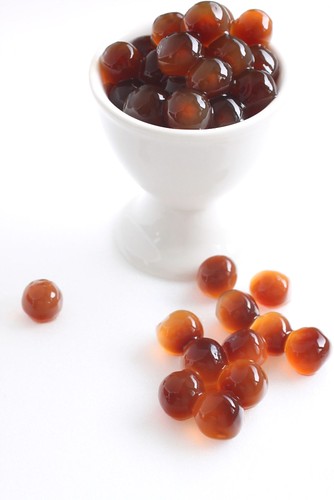
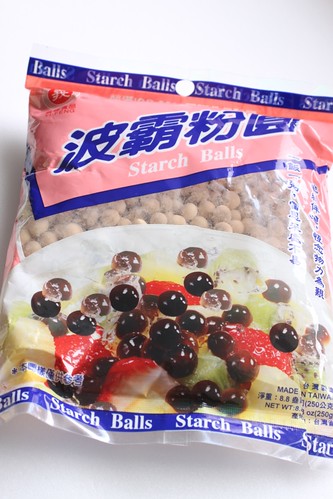
Anyway, the good thing that came out of this was that I was reminded of a packet of Starch balls which I have in my drawer. I thought I had bought this in Taiwan but the label behind the package had the address of the Singapore distributor and a $2.50 price tag. I strained my mind to recall where and when I had gotten this but my mind is blank. Curious if it is possible to achieve the same QQ texture as the shops with these, I followed the instructions and tried my luck.

IMG_2327

And dear readers, if like me, you are going primarily for the starch balls in these drinks, stop spending $3 for the drink - you can get a whole load of starch balls with this little packet. I brewed one of my favourite green tea (Gryphon's Jasmine Pearl Tea Infused with Rose) , blend it with the Lemongrass Passion Fruit Cordial which I had bought early this year from Jones Grocery, loaded it up with the Starch balls and I couldn't be more satisfied!

Bubble Tea
Now, all I need to do is to remember where I got these starch balls from... if anyone has seen it somewhere, do share - otherwise there are 2 actions I can take : call the distributor ; stock up during my next trip to Taiwan!

And oh, a gentle reminder : go easy on these store-bought milk tea - because they are laden with sugar and creamer - a cup a day expands waist line by 4 inches!!!

Bubbles 5(100)
Recipe
Starch Balls           100g
Water                    600g

Tea Bag                 1
Water                     500g (adjust strength according to personal preference)
Sugar                      1-2tsp (adjust sweetness to taste)

Lemongrass Passion Fruit Cordial (from Jones)  1/2 tbsp (adjust according personal preference, other cordials can be used)

Method:

1. Boil 600g water in a pot. Add Starch balls in to boiling water. Stir and wait for water to come to boil again. Remove from heat once boiling begins again and transfer content into an electric rice cooker. Cook in the rice cooker for about 1 hour until balls are cooked through. (Overcooking will result in soft mushy starch balls. Undercooking will render the center of the ball uncooked)

2. Drain and pour starch balls into ice cold water to prevent starch balls from sticking together.
3. In a separate pot, boil 500g water and add tea bag. Boil tea bag for 1 min, add sugar and turn off heat and let tea bag steep until desired strength is achieved. Cool down tea.
4. Add tea, ice cubes and cordial into a cocktail shaker. Shake well to blend and pour into a glass with starch balls. Enjoy drink.

Thursday, June 17, 2010

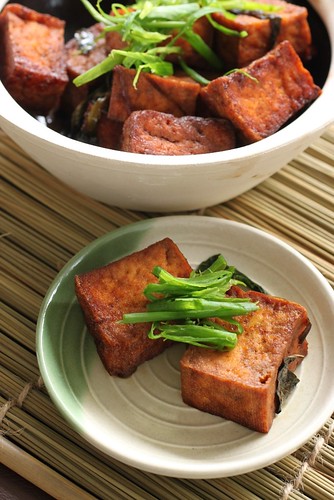
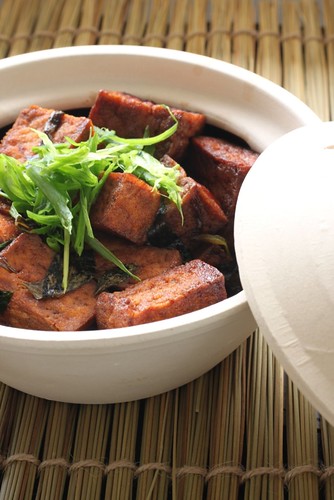
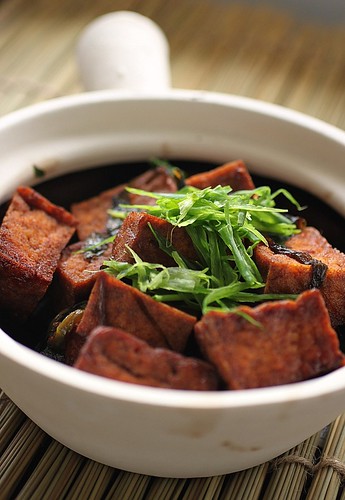
3 Cups Tofu 三杯豆腐


Tofu 4

Tofu 11
I believe the best 3 Cups Chicken (三杯鸡) I've had to date was prepared in Taiwan. My Taiwanese colleague had told me that every Taiwanese restaurant would most definitely have this dish on their menu. A restaurant which does not serve 3 Cups Chicken is not an authentic Taiwanese restaurant. Indeed, the Taiwanese have mastered this so well, that you can order almost anything to be cooked in this manner. In addition to the chicken, I've had 3 Cups Frog Legs (三杯田鸡), 3 Cups Eel (三杯鳗鱼), 3 Cups Eggplant (三杯茄子) and my favourite of all, 3 Cups Tofu (三杯豆腐).

The 3 Cups in the recipe denotes equal portions of Sesame Oil, Soya Sauce and Chinese Rice Wine. The Soya Sauce imparts the taste to the dish while the sesame oil and rice wine seduce the palate and senses with their heady fragrance... hence, very often, one is already sold by the warm, comforting smell even before tasting it. The single main ingredient in the dish is fried with all 3 cups of liquid and left to absorb the flavour over strong fire braising until all the liquid dries up and the whole dish tether dangerously at the brink of being burnt. In Taiwan, a 4th intoxicating element is added to the dish and that is Basil leaves (九层塔). The herbal infusion is so addictive that I have come to decide that any 3 Cups dish prepared without Basil leaves is just not right.

Tofu 10

I have never cooked any 3 Cups dishes and would not have been motivated to do it if not for seeing a recent post by 3 Hungry Tummies.(and yes, she used Basil Leaves!) Instead of using Chicken, I decided to try my hand at doing this with Tofu. A little more challenging because Tofu unlike meat dishes, will take longer to absorb flavours. The best 3 Cups Tofu dishes I've had in Taiwan are the ones that manage to draw in the flavours (入味).

Hence armed with the basics from 3 Hungry Tummies' post, I proceeded to prepare my Tofu dish. My Tofu had alot of flavour but I suspect that I could have chosen the wrong Tofu for this dish. Using pressed Tofu (板豆腐) , this is firmer and not as smooth. The Tofu I remembered from Taiwan was softer in the center. I am now thinking, if I had used Silken Tofu, I will end up with a Tofu that would be softer in the center. Well no full marks for this attempt but at least I had the heady fragrance envelope the whole neighbourhood - my neighbour actually knocked on my door and asked me what I was cooking.... (smile)

Tofu 7(100)
Recipe :

Tofu                 1 Square cut into cubes

Garlic               8 cloves
Spring Onions  4 stalks (with bulb) cut into 5cm length
Ginger              3cm slices
Basil Leaves     1 cup

Light Soya Sauce            3 tbsp
Sesame Oil                     3 tbsp
Chinese Rice Wine          3 tbsp
Sugar                              1/4 tsp
Water/ Chicken stock      1 cup

Method

1. Deep fry tofu cubes in oil at 160C to get nice brown crispy skin.
2. Drain and set aside.
3. Heat up a wok to smoking. Add sesame oil. Fry garlic, and ginger briefly until fragrant. Add Tofu, Soya Sauce,and sugar. Fry over high heat for 1 min.
4. Add water/chicken stock. Continue to fry until half of the liquid is evaporated. Add wine,spring onions and cover. Braise until liquid is almost dry. Add in Basil leaves and stir fry quickly and dish out.
    

Tofu on Foodista

Tuesday, June 15, 2010

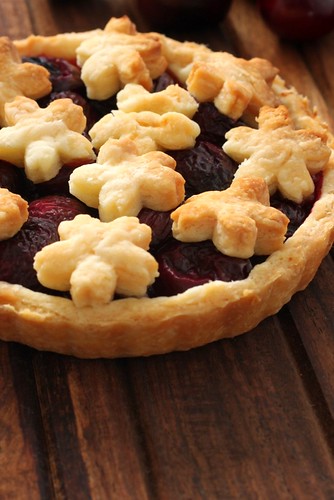
Cherry Pie


Cherries 5

Cherries 7

Cherries 4
Every so often, I get mesmerised by the photolicious creations I see at blogs and tell myself, I am bookmarking this to try as soon as possible. However, this always get side tracked and even forgotten once other priorities at work, not to mention plain tardiness set in. I have thought about this to myself so often - so many lovely dishes yet so little time to cook - not to mention so little calorie allowance to take them in...

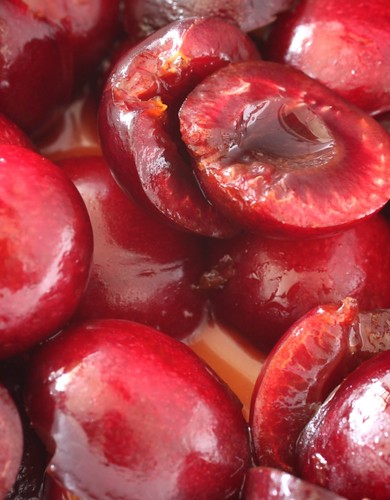
I chanced upon Dana's lovely blog, One Haute Plate last week while reading Amelia's blog. Dana's latest post featured a cobbler/pie made with seasonal cherries. I have never really baked with cherries but have always liked the tartness of cherries in pastry. Cherries must be in season now for I am actually seeing these being sold at the vegetable stall at the wet market here.

Cherries
Using Dana's Recipe, I decided to prepare 2 variations :
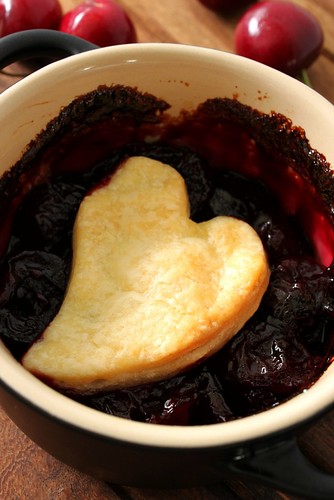
1) the lazy cobbler style where I simply placed the cherries in a little casserole and top it with a piece of pastry.
2) the mini pie version where the cherries are placed in a pie shell.

The cobbler style has a rustic appeal to it but had me stumped when I tried to photograph it.  The pie version, turned out well and was a breeze to photograph. The baked cherries were tart and delicious but what really delighted me was the flakiness of the pastry. I was expecting a texture akin to a typical sweet tart dough but was pleasantly suprised by the light and flaky pastry. If you could peer closely at the photos, you may be able to catch the flaky layers in the cross section of the pastry.
Absolutely delightful and  I can't wait to bake some more...

Cherries (100)
Recipe (from One Haute Plate, halved recipe)

Fresh cherries, pitted, 350g
Sugar , 2-3  tbsp (I cut down the sugar)
Cornstarch, 1.5 tbsp
Water, 1 tbsp
lemon juice, fresh, 1/2 tbsp

All-purpose flour, 165g
Salt, Pinch
Butter, chilled, unsalted, 113.5g
Ice water  1-2 tbsp
Sugar, for sprinkling

Method :

-Wash and pit cherries. Place in large mixing bowl and add cornstarch, sugar, water, and lemon juice. Mix together and set aside for 10+ minutes.

-Mix flour and salt, and using a fork, pastry cutter, or better yet, Cuisinart, blend flour mixture and butter together until crumbly.
-Slowly blend in 2-3 tbsp iced water until mixture adheres together, but is not too sticky. Add a little more water if necessary. Refrigerate for 10 min when finished.
-Set oven to 200C and butter a pie or casserole dish. Stir cherry mixture and transfer to dish.
-Roll out dough and use a cookie cutter to create 2-4 inch shapes of your choice (a water glass can stand in for this if need be). Layer dough shapes evenly with a 1/4-1/2 inch overlay to insure even baking.
-Sprinkle crust with sugar and bake for 45-55 minutes or until filling has gelled and the crust has browned. (I omitted this)

LinkWithin

Related Posts with Thumbnails